At What Cost? The Controversy Surrounding Black and Latino ICE Agents

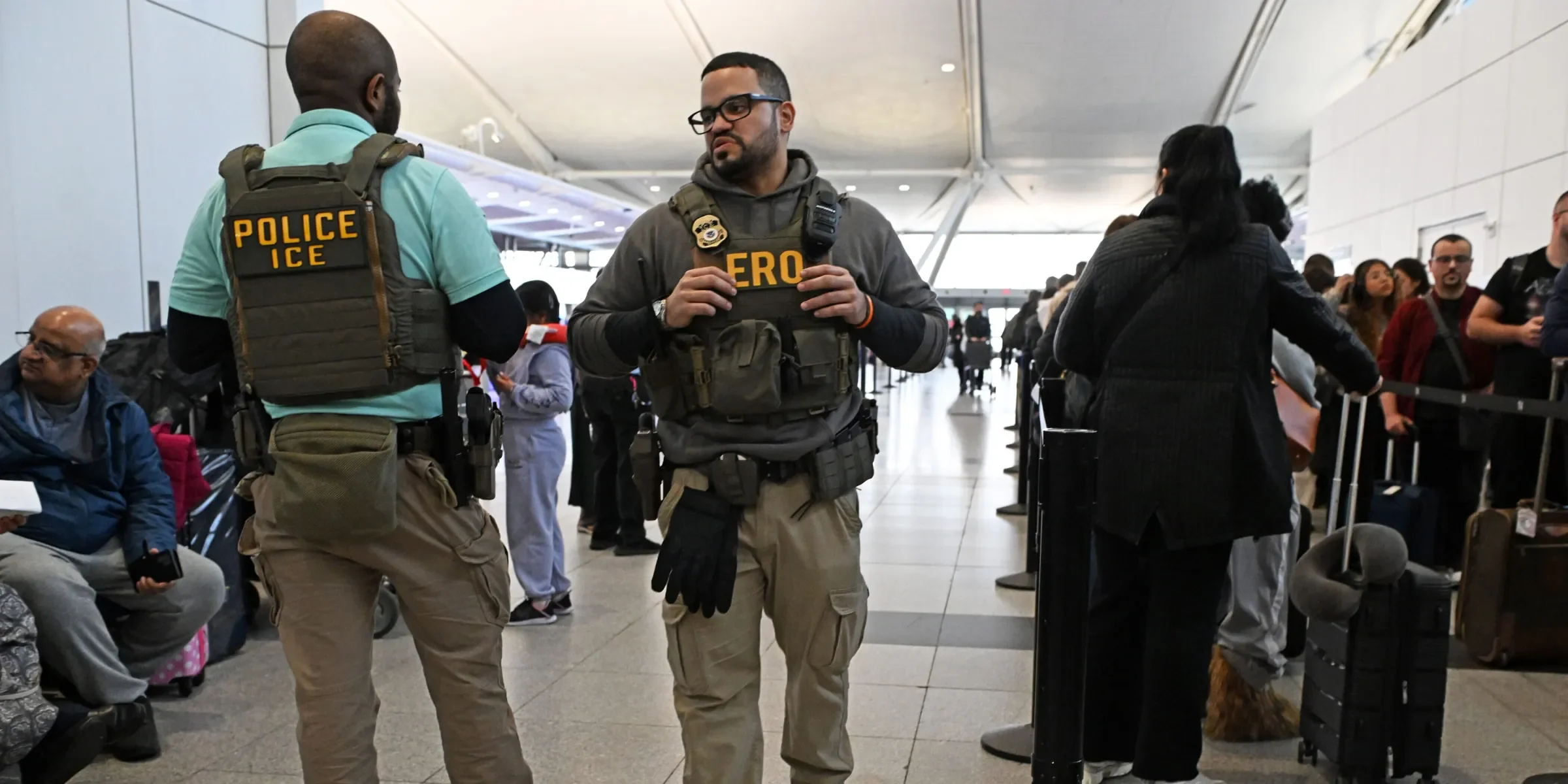
New York City - ICE agents occupy John F. Kennedy International Airport on March 23, 2026.
Photo Credit: Andrea Renault/STAR MAX/IPx
By: Omar Cook
Los Angeles, CA — The presence of U.S. Immigration and Customs Enforcement (ICE) agents at major U.S. airports has sparked national debate. Deployed during a government shutdown to assist overwhelmed TSA workers, their visibility has not only raised concerns about airport security, but also reignited deeper conversations about immigration enforcement, race, and morality.
At the center of this conversation is a difficult and emotional question: what does it mean when Black and Latino officers are part of an agency accused of targeting communities that often look like their own?
Reports of aggressive immigration enforcement tactics have circulated widely with stories of individuals being detained at workplaces, separated from families, and in some cases, even U.S. citizens mistakenly apprehended. These incidents have contributed to a growing sense of fear, especially in immigrant communities and increasingly within Black communities as well.
Enforcement practices have expanded significantly in recent years, with many individuals detained despite having no criminal record. Additionally, legal rulings have allowed agents to consider factors like language, location, and appearance, raising serious concerns about racial profiling.
“Donald Trump has weaponized the agency and has turned them into a lawless militia that executes his authoritarian agenda.”
For many, the presence of ICE agents, now even in everyday spaces like airports, feels less like public safety and more like surveillance.
Historically, immigration enforcement has been viewed as an issue primarily affecting Latino communities. But recent developments show that the impact is broader. There have been increasing concerns about ICE activity in predominantly Black neighborhoods, including immigrant communities such as Somali Americans.
When one group is targeted, others often follow. This has led to a growing awareness that immigration enforcement is not just a “Latino issue,” but a broader human rights issue affecting multiple communities.
Perhaps the most uncomfortable part of the conversation is the role of Black and Latino ICE agents themselves.
On one hand, these individuals are professionals with many working to provide for their families in a difficult economy. Government jobs offer stability, benefits, and upward mobility, which are especially important in underserved communities.
But on the other hand, their presence within ICE raises moral and cultural questions. How do you reconcile enforcing policies that may harm communities you come from? At what point does a paycheck conflict with personal values?
Social media has amplified this debate, with many expressing disappointment, confusion, and even anger. There’s a prevailing sentiment that empathy should naturally exist within shared cultural experiences, but reality is often more complicated.
Seeing Black ICE agents doesn't sit right with my spirit. pic.twitter.com/68yNuDFTdR
— Covie (@covie_93) March 24, 2026
This conversation ultimately comes down to a deeper tension: survival versus morality.
Many people understand the need to “do what you have to do” to survive. But others argue that there must be a line; a point where individuals take a stand against systems that cause harm, even if it comes at a personal cost.
The truth likely exists somewhere in the middle. Not every agent shares the same beliefs, and not every action reflects the same intent. Some may see themselves as simply doing a job, while others may struggle internally with the impact of their work.
A Call for Unity and Accountability
What’s clear is that the current state of immigration enforcement is creating division, fear, and mistrust, and definitely not unity. Airports, communities, and public spaces are becoming points of tension rather than connection.
Leaders in power have a responsibility to prioritize policies that promote safety, fairness, and humanity. At the same time, communities must engage in honest conversations about accountability, empathy, and collective responsibility.
Because at its core, this isn’t just about ICE.
It’s about the kind of society we are building and whether we are moving toward unity or further apart.
Empathy is one of the most powerful forces we have as people. When it is missing, systems can become cold, mechanical, and harmful.
The conversation around Black and Latino ICE agents is not just about criticism, but about reflection. Reflection on choices, systems, and the values we uphold as individuals and as a nation.
And until empathy becomes central to those systems, the divide will only continue to grow.
EMPOWER YOURSELF
Ready to make a difference in your community and beyond? Start today with the ebook Civic Empowerment: A Citizen’s Guide to Effective Participation in Government — your roadmap to getting involved, influencing policies, and using your voice to shape the future.
👉 Grab your copy here and start shaping the future of your community—and our nation.

YOU MAY ALSO BE INTERESTED IN: