
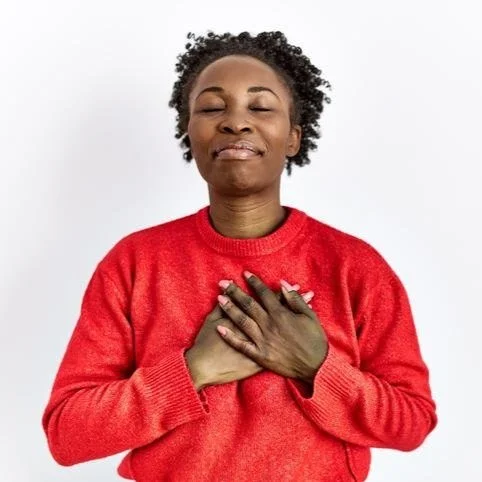
How to Hold Grief and Gratitude at the Same Time
Explore how grief and gratitude can coexist in the Black experience, revealing the healing power of embracing both pain and thankfulness in everyday life. We discuss it here!

Photo Credit: AaronAmat via iStockPhoto.com
By: Jamila Gomez
Grief and gratitude seem like emotional opposites. One cracks you open. The other grounds you. One is heavy, hard, and hollow. The other feels light, warm, and full. But the truth is, they often show up together — especially in the Black community, where we’ve had to become experts in holding contradictions.
We laugh at funerals. We sing through sorrow. We keep going, even when our hearts are breaking.
Grief and gratitude don’t cancel each other out — they exist side by side in the same breath.
Maybe you’re mourning a loved one but grateful you got to know them at all.
Maybe you’re grieving a version of yourself you had to let go of, while still being thankful for how far you’ve come.
Maybe life feels unfair right now, and yet you still find yourself smiling at the sky, or saying “thank you” in the quiet.
This is what it means to be human — to be Black — to be alive in a world that doesn’t always make sense but still holds moments of softness.
The trick isn’t choosing between grief and gratitude. The real healing starts when you give yourself permission to feel both — without guilt.
You’re allowed to cry and still appreciate the love that was real.
You’re allowed to miss someone deeply and still move forward with joy.
You’re allowed to say, “This hurts” and also say, “I’m thankful for what it gave me.”
In our culture, we’re often taught to be either broken or blessed. But we’re both. We’re layered. We carry sorrow in one hand and survival in the other.
So how do you hold them both?
Start small.
Say thank you for the little things, even on the hard days.
Make space to honor your grief — not fix it, not rush it, just witness it.
And when joy shows up — in laughter, in food, in sunlight on your skin — let it in. Don’t push it away just because you’re still hurting.
There is no right way to grieve. There is no perfect time to feel grateful. There is only the truth of what you’re holding right now — and the courage to hold it with care.
You don’t have to be all healed to be thankful.
You don’t have to be joyful every day to honor your blessings.
You are allowed to be both hurting and healing — grieving and grateful.
Both can be true. And both can lead you home.

YOU MAY ALSO BE INTERESTED IN:




SHARE TO SOCIAL MEDIA

Black Joy as Resistance: Embracing Happiness Despite Adversity
Black joy serves as a powerful act of resistance, celebrating the resilience and vibrancy of Black culture while countering systemic oppression. We discuss it here!

Photo Credit: PeopleImages via iStockPhoto.com
By: Jamila Gomez
Black joy is a powerful act of resistance, a deliberate choice to experience happiness in the face of systemic oppression, discrimination, and societal challenges. Historically, Black communities have been marginalized and subjected to systemic inequities, and while the narratives often focus on struggle, survival, and resilience, Black joy brings a transformative dimension to the fight for justice and equity. This joy is not merely about momentary happiness but is a profound assertion of humanity, dignity, and self-worth.
At its core, Black joy resists the notion that pain and trauma should define the Black experience. Throughout history, Black people have found ways to celebrate life despite adversity. Whether through music, dance, food, spirituality, or storytelling, Black joy has always been interwoven with culture and identity. From the rhythms of jazz, soul, and hip-hop to the laughter shared at family gatherings and the joy expressed in Black art, each act of joy is a reminder of the richness of Black culture and heritage. These expressions challenge limiting narratives and reinforce a broader, more authentic view of what it means to live and thrive as a Black person.
Black joy is also an antidote to oppression, a way of reclaiming agency in a world that often tries to strip it away. Rather than passively enduring hardship, embracing joy disrupts narratives of victimhood and instead cultivates strength and resilience. It is a way of saying, “We will not let the weight of injustice rob us of our humanity.” This joyful resistance is evident in the celebration of Blackness, the appreciation of shared history, and the embracing of community. By choosing to revel in the beauty of Black life, Black communities resist systems that have attempted to devalue and marginalize them.
Furthermore, Black joy can create space for healing, community, and solidarity. It allows Black individuals to affirm their identities, celebrate each other’s successes, and draw strength from shared experiences. This joy is contagious, spreading a message that Black lives are not defined solely by struggle but are filled with love, laughter, and triumphs.
In embracing Black joy as resistance, Black communities refuse to be solely defined by their struggles. Instead, they assert a powerful, enduring message: that Black life, in all its beauty and vibrancy, is worth celebrating. Black joy is a testament to the resilience and richness of Black culture, a radiant light that continues to shine, undeterred by adversity.
YOU MAY ALSO BE INTERESTED IN: